






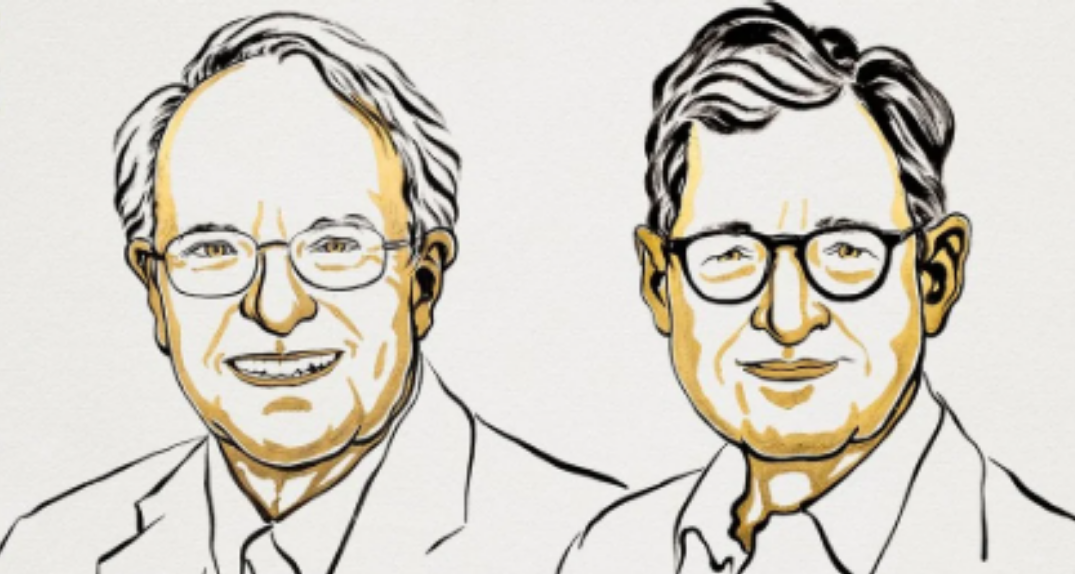
Nobel Prize in Economics in 2026
(Graphic: Niklas Elmehed, Nobel Prize Outreach)
The Sveriges Riksbank Prize in Economic Sciences in Memory of Alfred Nobel, popularly known as the Nobel Prize for Economics, was awarded in 2026 to Robert E. Hall and Michael Woodford.
The official statement of the Royal Swedish Academy of Sciences states that that the authors laid the foundations for macroeconomic models derived from the microeconomic decision-making principles of economic agents—specifically households and firms. Robert E. Hall introduced the role of expectations regarding future developments into the analysis of household consumption; in its purest form, his consumption theory suggests that household consumption is essentially unpredictable. Michael Woodford presented one of the first models of the type commonly known as New Keynesian macroeconomic models.
The statement and a more detailed commentary from the Swedish National Bank states that the laureates contributed significantly to a better understanding of macroeconomic fluctuations, thereby facilitating the formulation of superior monetary and fiscal policy measures capable of mitigating such fluctuations. As always, it is useful to step back and view the issue with some perspective. It is worth noting that these models failed completely during, for instance, the financial crisis that erupted in the US in 2007, spread to certain EU economies in 2008, and—through subsequent adverse effects—negatively impacted economic performance across the entire EU. More generally, it is safe to assert that these models are fundamentally incapable of predicting severe—and, above all, prolonged—macroeconomic fluctuations. For the same reason, the results of simulation exercises using these models are essentially unusable for situations where the economy has clearly deviated significantly from its long-term equilibrium.